
Sourcing butterfly weft hair extensions without understanding the structural differences between categories is a fast route to client complaints and costly returns. Buyers who treat all butterfly weft SKUs as interchangeable quickly discover that construction details — not marketing labels — determine whether end clients rebook. Understanding the full butterfly weft category is the first step toward making a defensible sourcing decision.
Butterfly weft hair extensions fall into four main structural categories: PU butterfly weft, genius weft plus punched PU weft, genius butterfly weft, and invisible tape-in weft plus PU weft. Each category combines different base construction methods and sealing techniques, producing distinct weight profiles, installation compatibility, and edge behavior. The right category depends on your client profile, your stylists' installation methods, and the quality consistency your supplier can actually deliver across reorders.

These four categories are not cosmetic variations. Each one reflects a different set of production decisions — wax thread placement, PU seam width, punching pattern, adhesive layering — that directly affect how the weft behaves after install. Before you commit to a SKU, you need to understand what you are actually buying at the construction level.
What Are the Main Categories of Butterfly Weft Hair Extensions?
Most buyers assume butterfly weft is a single product type. That assumption leads to mismatched orders, inconsistent quality across reorders, and stylists who cannot replicate their results batch to batch. The structural differences between categories are significant — and they are visible at the production level long before the hair reaches your customer.
The four butterfly weft categories — PU butterfly weft, genius weft plus punched PU weft, genius butterfly weft, and invisible tape-in weft plus PU weft — each use a different base weft construction combined with a specific sealing or adhesive method. These combinations determine the weft's thickness profile, cutting behavior, installation compatibility, and how consistently it performs across production batches.
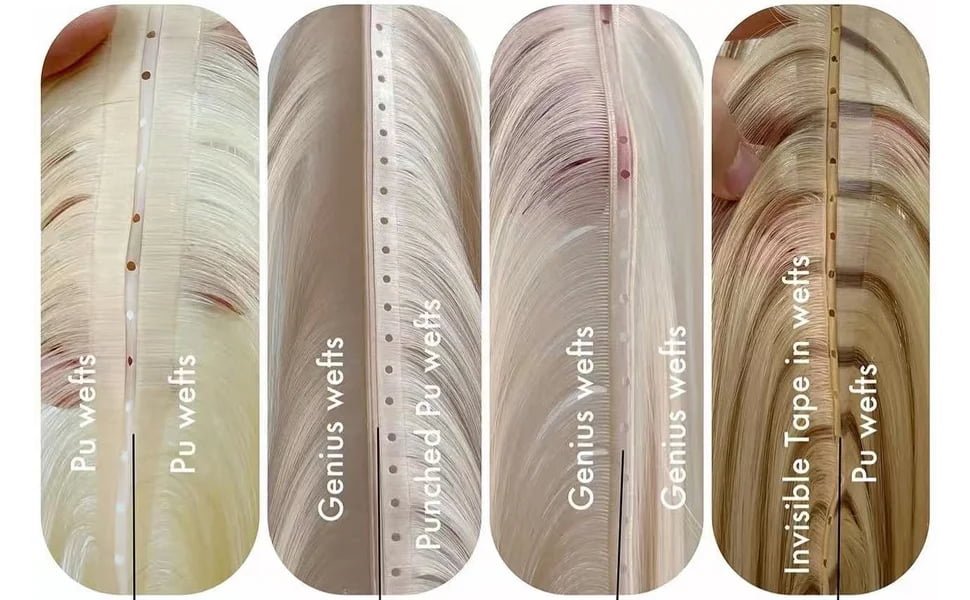
Understanding each category helps you ask the right questions during supplier qualification — not just about the finished product, but about the production variables that determine consistency.
Category 1: PU Butterfly Weft
PU butterfly weft uses a polyurethane strip applied along the weft seam to seal individual hair strands in place. In our production process, the PU layer serves two functions: it creates a flat, smooth seam profile, and it locks each strand at its root position so the weft can be cut to any width without shedding at the cut edge.
The key production variable buyers should ask about is PU strip width and coverage consistency. A strip that is too narrow leaves strand positions unlocked toward the edge, which causes shedding when stylists trim the weft on-site. A strip applied unevenly across a bundle creates inconsistent seam thickness — something a stylist will notice immediately during installation.
What to verify with your supplier:
- Minimum PU strip width across the full weft length
- Whether the PU layer is applied by machine or hand (machine application is more consistent)
- Weight tolerance per bundle — PU adds weight, and inconsistent application means inconsistent bundle weight
- How cut edges behave after the PU seam is trimmed — ask for a sample cut test before ordering
PU butterfly weft sits flat against the scalp and works well for clients who want a low-profile install. It is not the best choice for clients seeking significant volume or body — for that, you need a construction with more strand density built into the weft itself.
Category 2: Genius Weft + Punched PU Weft
This category combines a genius weft base — a machine weft constructed with tighter wax thread lock-stitching — with a PU strip that has been mechanically punched to create openings along the seam band. Those punched openings serve a specific functional purpose: they allow the installer to thread beads or rings directly through the weft seam without splitting or cutting the base.
In our production process, the punching pattern is controlled for two variables: hole spacing and hole size. Holes that are too close together weaken the seam structure. Holes that are inconsistently sized affect bead threading speed during installation — a practical detail that matters to stylists working at volume in a salon environment.
Why this category matters for distributors:
Genius weft plus punched PU weft is positioned for the beaded install market. If your primary buyer network includes stylists trained in beaded row or NBR methods, this construction is designed for their workflow. The PU layer maintains the cut-without-shedding property, while the punched openings remove a step from the installation process.
What to verify with your supplier:
- Punching consistency across the full weft length (ask for a production sample, not a marketing sample)
- Whether the PU application happens before or after punching — sequence affects seam integrity
- Seam flatness after punching: if the PU is stressed by the punching process, it may lift at edges
- Weft weight before and after punching — punching removes material and should be accounted for in weight specs
| Specification Point | What Inconsistency Looks Like in Practice |
|---|---|
| Hole spacing | Bead placement is uneven; stylist workflow slows |
| PU seam integrity post-punch | Seam lifts or splits at punched edges after install |
| Weight per bundle | Bundle-to-bundle variation affects billing by weight |
| Cut edge behavior | Strands shed if PU coverage is insufficient near holes |
Category 3: Genius Butterfly Weft
Genius butterfly weft uses the genius weft construction — tighter wax thread density, more controlled lock-stitch placement — without a PU overlay. The name "butterfly" in this context refers to the weft's body profile: the strand arrangement creates a naturally fuller, more voluminous drape compared to a standard flat machine weft.
This is where the butterfly weft category occupies its clearest market position. It fills the gap between hand-tied weft and machine weft. Hand-tied weft lies extremely flat and is ideal for fine-haired clients needing an invisible install, but it provides limited volume support. Standard machine weft is dense but has raw, unfinished seam edges that shed when cut. Genius butterfly weft offers more body than hand-tied and cleaner edge behavior than a standard machine weft — without the PU weight addition.
In our production process, achieving the butterfly body profile consistently requires controlling wax thread density across the full weft length. Sections of a weft with lower thread density will lie flatter, creating visual inconsistency when the hair is installed in sections. Before shipment, we check for density uniformity by measuring thread count per centimeter at three points along each weft: the center and both ends.
Which client profile does genius butterfly weft actually serve?
- Clients with medium-density natural hair who want visible volume, not just length
- Clients who have had previous installs with hand-tied weft and want more body
- Stylists working with sew-in or beaded flat-track methods — this weft is not compatible with tape-in or bonded methods
- Markets where a mid-price product is needed between premium hand-tied and commodity machine weft
What to ask your supplier before ordering:
- How is wax thread density measured and documented per production batch?
- What is the acceptable weight tolerance per bundle, and how is that checked before packing?
- What causes batch-to-batch variation in the butterfly body profile — and what controls are in place?
Category 4: Invisible Tape-In Weft + PU Weft
This category combines the thin, seamless profile of an invisible tape-in structure with a PU weft construction. The result is a hybrid that functions both as a weft (for sew-in or beaded install) and as a tape-in extension, depending on how the stylist applies it. The PU base in this construction is thinner than in standard PU butterfly weft — the priority here is invisibility at the scalp, not just edge sealing.
In our production process, the challenge with this category is controlling base thickness without sacrificing seam strength. A PU layer that is too thin to achieve an invisible profile may not adequately lock strand positions at the edge — which means shedding risk increases. This is a construction trade-off that buyers need to understand before they stock this SKU.
Who this category is for:
- Salon buyers serving clients with fine or low-volume natural hair who need invisible integration
- Brand owners targeting a premium positioning in markets where invisible installs are a key selling point (this is particularly relevant in Japan and parts of Western Europe)
- Buyers whose stylist network has experience with both tape-in and weft install methods — this category requires method flexibility
Pre-order verification points:
- Request a sample and check seam visibility when the weft is held against light — this is the practical invisibility test
- Ask for base thickness measurement — not a marketing claim, a documented specification
- Verify that the PU adhesive used in the tape-in component is heat-resistant to avoid slippage in warm or humid salon environments
- Confirm the weft's behavior when re-taped for second applications — some buyers use this for multi-use cycles
How Do You Install Butterfly Weft Hair Extensions?
Stylists who receive butterfly weft extensions without clear installation guidance make costly mistakes — wrong bead size, incorrect sectioning, or attempts to apply a sew-in weft with tape-in methods. For B2B buyers, this is not just a training issue: it is a returns risk and a reputation risk. Choosing the wrong butterfly weft category for your stylists' skill set is a supplier selection mistake, not a product defect.
Butterfly weft hair extensions are installed using flat-track sew-in, beaded row, or tape-in methods depending on the specific category. PU butterfly weft and genius butterfly weft are compatible with beaded or sew-in installs. Invisible tape-in plus PU weft supports tape application. Genius weft with punched PU weft is specifically designed for bead-threading installs. No butterfly weft category is suitable for bonded (fusion) or pre-bonded application methods.
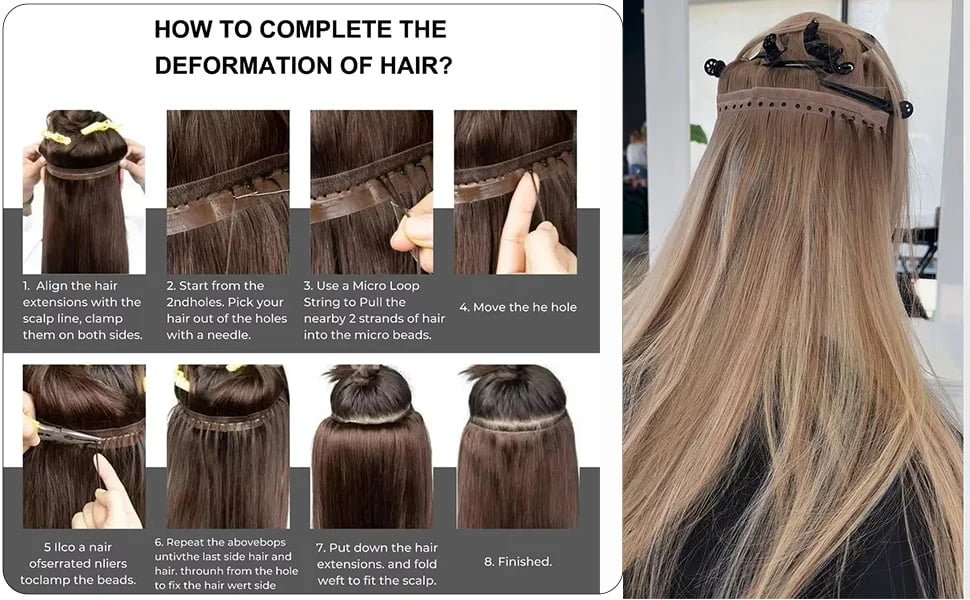
Installation compatibility is an underexplained selection factor in most supplier conversations. Here is a structured breakdown of how each category installs and what skill level it requires.
Installation by Category
PU Butterfly Weft — Beaded Row or Flat-Track Sew-In
The PU seam is flat enough for close-to-scalp bead placement. Stylists section the natural hair into horizontal tracks, attach micro-rings or beads to the track foundation, and loop or sew the weft along the track. The weft can be pre-cut to the client's head width — the PU seam prevents shedding at cut points.
- Skill level required: Intermediate to advanced
- Tools needed: Micro-rings, pulling needle, thread or nylon cord
- Key stylist consideration: PU seam must sit flat against the track — if beads are overtightened, the seam can create a visible ridge
Genius Weft + Punched PU Weft — Bead-Through Install
The punched openings in the seam allow the stylist to thread micro-rings directly through the weft band, eliminating the need for a separate foundation row. This is a faster installation method for experienced stylists working in high-volume environments.
- Skill level required: Advanced (requires familiarity with bead-through technique)
- Tools needed: Threading needle, micro-rings compatible with the punched hole size
- Key stylist consideration: Bead size must match hole diameter — ask your supplier for the punched hole specification so your stylists can prepare the correct bead size
Genius Butterfly Weft — Sew-In or Beaded Row
This category does not have a PU or punched component, so installation relies on the weft body sitting on a beaded or sewn track. The fuller body profile means this weft sits slightly higher off the scalp than PU categories — account for this in sectioning.
- Skill level required: Intermediate
- Tools needed: Thread and needle or micro-rings, depending on method
- Key stylist consideration: This weft is not designed for tape application — the weft body will not lie flat enough for adhesive to hold reliably
Invisible Tape-In Weft + PU Weft — Tape-In or Beaded
This is the most installation-flexible category, but it requires the stylist to understand both methods. For tape-in application, the stylist sections 1–2cm horizontal partings and sandwiches the natural hair between two weft panels. For beaded application, the thin PU base allows very close scalp placement.
- Skill level required: Intermediate to advanced
- Tools needed: Tail comb for clean sectioning, heat source for reapplication if re-taping
- Key stylist consideration: Tape-in adhesive must be fully adhered — press firmly for 10–15 seconds per section. In warm climates or for active clients, confirm the adhesive heat resistance specification with your supplier before stocking.
A Pre-Purchase Conversation Worth Having
Before you finalize a butterfly weft category order, I recommend asking your stylist network two questions:
- What installation method do you predominantly use? The answer determines which category is structurally compatible with their workflow.
- What is the most common client complaint after weft installs? If the answer involves shedding, that points to PU construction. If it involves bulk or weight, that points to category weight specs.
These conversations take five minutes and prevent a three-month returns cycle.
Frequently Asked Questions
What is the difference between butterfly weft and regular machine weft?
Standard machine weft has raw, unfinished seam edges that shed when cut. Butterfly weft uses a PU seam, tighter lock-stitch construction, or a combination of both to allow clean cutting without edge shedding. The construction also creates a fuller body profile than flat machine weft, serving clients who need volume alongside length.
Can butterfly weft hair extensions be cut to size?
Yes — but only if the seam construction supports it. PU butterfly weft and genius weft plus punched PU weft are specifically designed to be cut to any width without shedding at the cut edge. Genius butterfly weft without a PU layer carries more shedding risk at cut points. Always confirm the cut behavior with your supplier before distributing to stylists.
What should I ask a butterfly weft supplier before placing a first order?
Ask for documented production specifications: PU strip width, wax thread density per centimeter, bundle weight tolerance, and seam flatness measurements. Request a physical sample and perform a cut test before ordering at volume. The quality risk with butterfly weft is not visible at ordering — it appears after the stylist installs the hair.
How do I know which butterfly weft category is right for my client base?
Match the category to your clients' hair profile and your stylists' install methods. Fine-haired clients needing invisible integration suit invisible tape-in plus PU weft. Clients wanting volume suit genius butterfly weft. Stylists trained in beaded row methods with bead-through technique suit genius weft plus punched PU weft. There is no universally superior category — the match is contextual.
How does batch-to-batch consistency affect butterfly weft quality?
Inconsistency across batches — in wax thread density, PU layer coverage, or bundle weight — creates visible variation when stylists install hair from different reorders. This directly affects end-client results and rebooking rates. Before committing to a supplier, ask how they document and control production variables across batches, not just within a single sample shipment.
Conclusion
Butterfly weft hair extensions are not a single product — they are a category with four structurally distinct types, each built for a specific client profile and installation method. PU butterfly weft, genius weft plus punched PU weft, genius butterfly weft, and invisible tape-in weft plus PU weft each reflect different production decisions that determine real-world performance after install. The sourcing decision is not which butterfly weft looks best in a product photo — it is which construction your market actually needs, and whether your supplier can document that they deliver it consistently across reorders.
At Xpertric, we manufacture all four butterfly weft categories across five production lines in Qingdao, China. We welcome questions about our production specifications — wax thread density, PU strip width, seam flatness tolerances — before you place your first order. Reach out to Sheilla at info@xpertric.com or visit www.xpertric.com to request samples and production documentation.