Feather hair extensions are back in demand — but choosing the wrong format for your market can cost you margin, brand reputation, or both. Buyers often ask which type is better. That framing misses the point. The real question is which format matches your end channel, your price tier, and your volume model.
Feather hair extensions come in two production formats: hand tied and machine made. Hand tied extensions are crafted manually by skilled workers, resulting in a softer weft and more natural drape — ideal for premium or salon-facing channels. Machine made extensions are produced with automated equipment for consistent output at lower per-unit cost, making them the stronger choice for volume-driven, price-sensitive retail distribution. Neither format is universally superior. The right choice depends entirely on what your customers are paying for.
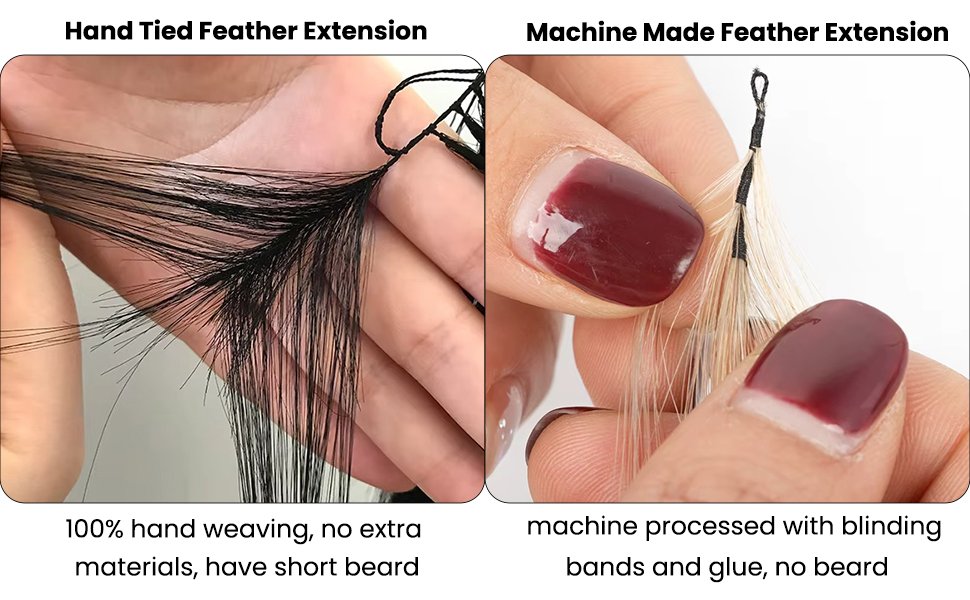
Both formats exist because different buyers serve different markets. Understanding how each is made — and what that means for your sourcing risk — is what this article covers. The sections below break down each format, then give you a practical framework for deciding which one belongs in your product line.
What Are Hand Tied Feather Hair Extensions?
Buyers sourcing for premium channels often hear "hand tied" positioned as the gold standard. But without understanding what the production process actually involves, that label becomes just marketing language — and you can't verify what you're paying for.
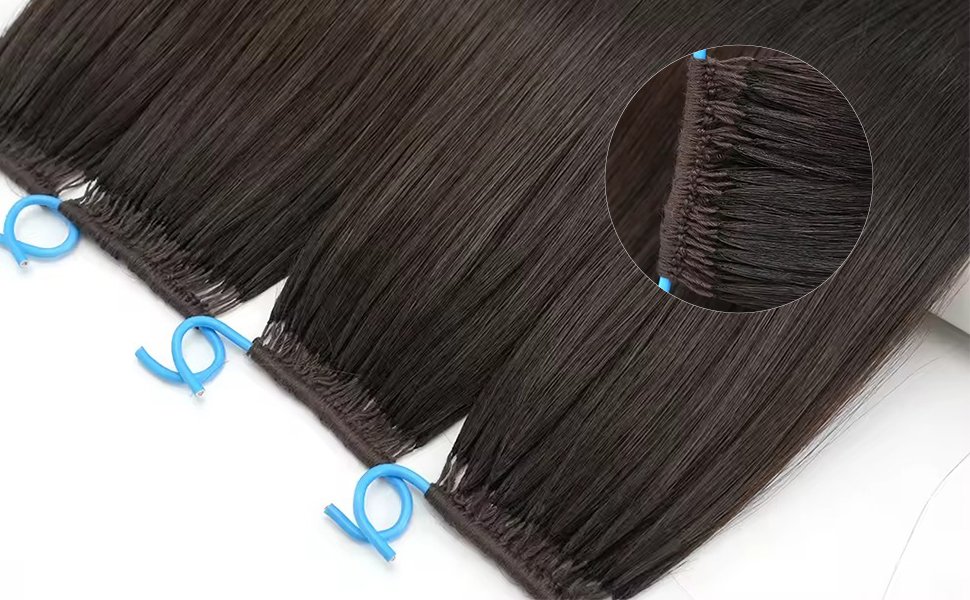
Hand tied feather hair extensions are extensions where individual hair strands or small bundles are manually tied onto a thin weft by skilled workers. The result is a flat, lightweight weft with minimal bulk at the root — making it highly suitable for fine hair clients and salon application methods. The quality of the finished piece depends directly on the skill level of the individual worker.
What Goes Into Making a Hand Tied Weft
In our production experience, hand tied wefts require significantly more labor hours per unit than machine made alternatives. Each weft is assembled strand by strand. The tying tension, row spacing, and thread selection all affect how the finished extension sits on the head and how long it holds up under repeated washing and styling.
Key characteristics of the hand tied production process include:
- Labor intensity: Skilled workers complete each weft manually. Output per worker per shift is lower than machine production.
- Worker consistency dependency: Two workers with different experience levels can produce wefts with measurably different feel and durability — even using the same raw materials.
- Rejection rate sensitivity: Inconsistency in tying tension or alignment can result in shedding or uneven drape. A well-run production line has a defined QC step that catches these defects before packing.
- Customization flexibility: Because the construction is manual, modifications to weft width, row count, and feather layering are relatively straightforward to accommodate.
What Buyers Should Ask When Evaluating Hand Tied Feather Extensions
The craft label alone doesn't tell you much. Based on inquiries we receive from wholesale buyers and distributors, the questions that actually reveal supplier quality are:
| Evaluation Area | Question to Ask Your Supplier |
|---|---|
| Worker skill | How do you train workers, and how long before a worker produces production-grade wefts? |
| Consistency | Do you perform per-piece tension or shedding checks before packing? |
| Rejection handling | What happens to rejected pieces — are they reworked or discarded? |
| Raw material traceability | Can you confirm the hair grade and origin used in hand tied SKUs? |
Buyers who skip these questions are making a decision based on format name rather than production reality. If a supplier can't answer them clearly, that's a meaningful signal.
When Hand Tied Feather Extensions Justify the Premium
Hand tied construction produces a weft that sits flatter against the scalp, sheds less when properly made, and has a more natural movement pattern. These properties matter to a specific type of end customer — typically salon clients and consumers paying for a premium install experience.
If your downstream channel is:
- Professional salons that install extensions and stand behind the result
- Premium retail brands where the end customer is paying for quality perception
- Customized or private label lines where construction quality is part of the brand story
— then hand tied feather extensions justify sourcing at a higher per-unit cost. The value lands because the end customer is evaluating it.
If your channel is volume retail with price-conscious consumers who are less focused on construction subtleties, you are likely paying for craft that doesn't translate into revenue.
What Are Machine Made Feather Hair Extensions?
Machine made extensions carry an unfair reputation in some buyer conversations. The assumption is that "machine made" means lower quality. In our QC experience, that assumption conflates production method with output standard — and it leads buyers to overpay for hand tied product in markets where the difference is invisible to the end user.
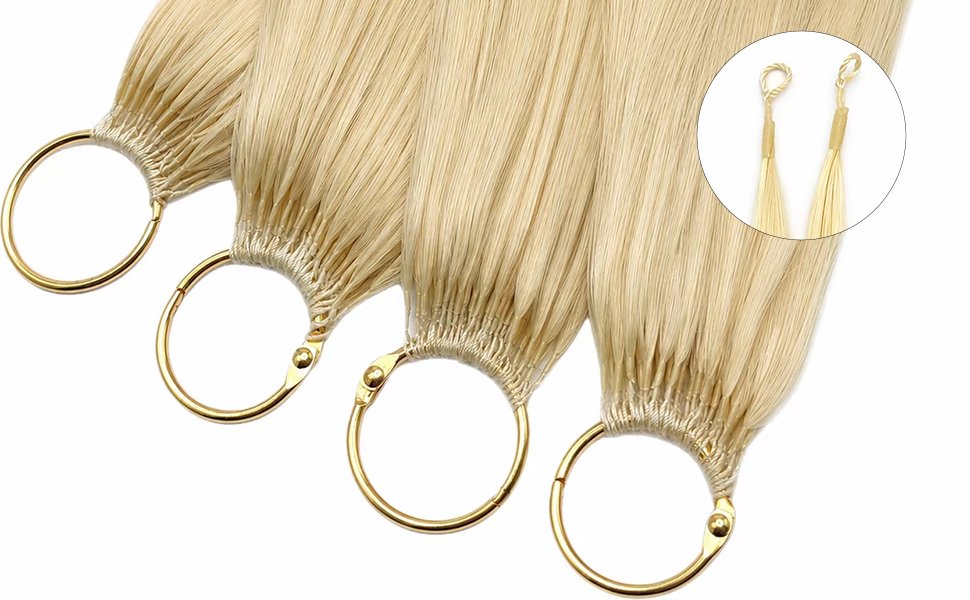
Machine made feather hair extensions are produced using automated weaving or weft machines that feed hair strands through a mechanized tying or stitching process at consistent speed and tension. The output is a uniform weft with predictable specifications across a production batch.
How Machine Production Changes the Risk Profile
The key difference between hand tied and machine made is not quality ceiling — it is consistency and cost structure. Machine production removes the variable of individual worker skill. Every weft in a batch is produced under the same tension, spacing, and speed parameters. That uniformity is a feature, not a limitation.
From a buyer's perspective, this matters in the following ways:
- Batch-to-batch consistency: Reorder quality matches original order quality, assuming machine calibration is maintained. This reduces complaints from retail customers who receive a second purchase that feels different from their first.
- Lower per-unit labor cost: Machine production reduces labor hours per weft significantly. That cost reduction passes through to your unit economics.
- Faster turnaround: Higher output volume per shift means shorter lead times for large orders — a meaningful advantage for buyers managing seasonal demand or promotional cycles.
- MOQ flexibility: Lower production cost per unit often gives manufacturers more flexibility on minimum order quantities for standard SKUs.
What Buyers Should Verify in Machine Made Production
Machine made does not mean quality-guaranteed. Equipment calibration, raw material input, and post-production QC determine whether the batch meets specification. Buyers evaluating a machine made supplier should ask:
| Evaluation Area | Question to Ask |
|---|---|
| Equipment calibration | How frequently are machines calibrated, and are records available? |
| Batch uniformity | How do you test for weight or density consistency across a production run? |
| Shedding and tangle testing | What post-production checks are applied before packing? |
| Raw material input | What hair grade goes into standard machine made SKUs, and can you provide documentation? |
A supplier that cannot speak to calibration or batch uniformity testing is not managing quality — they are shipping and hoping.
Where Machine Made Feather Extensions Perform Best
Machine made feather extensions are the stronger sourcing choice when:
- Volume is the priority. You are moving units at scale and per-unit cost determines your margin.
- Your retail channel is price-sensitive. End consumers are buying based on aesthetic appeal and price point, not installation technique.
- Reorder consistency matters more than craft perception. Repeat buyers in retail want the product to look and feel the same every time.
- You are filling out a product range. Not every SKU in your line needs to be a premium craft product. Machine made feather extensions can serve as strong mid-tier or entry-level options that extend your catalog without inflating your sourcing cost.
The honest framing: machine made extensions are not a fallback for buyers who can't afford hand tied. They are the right tool for a specific market segment — and in high-volume distribution, they often outperform hand tied on total business return.
How to Choose Feather Hair Extensions for Your Business?
Most sourcing decisions go wrong not because the buyer chose the wrong format — but because they applied one format to the entire product line without thinking about who is actually buying each SKU.
The decision between hand tied and machine made feather hair extensions should be driven by your end channel, your customer's sensitivity to construction quality, and your margin model — not by format prestige.

A Practical Decision Framework
Use the following questions to guide your sourcing decision:
1. Who is your end customer, and what are they paying for?
If your customer is a salon or a premium retail buyer, construction quality is visible and valued. Hand tied feather extensions support that story. If your customer is buying off a website based on photos and price, machine made delivers comparable visual appeal at better unit economics.
2. What is your target retail or wholesale price point?
Hand tied production costs more. That cost needs to pass through to your margin. If your channel can't support a higher price, the premium becomes a sourcing loss rather than a value driver.
3. Do you need the same format across all SKUs?
In our buyer consultations, one common mistake is treating the sourcing decision as all-or-nothing. A well-structured product line might use:
- Hand tied for hero SKUs positioned as salon-grade or premium
- Machine made for filler SKUs, value bundles, or introductory offerings
This dual-format approach lets you serve different customer segments within the same catalog without overpaying across the board.
4. What does your reorder model look like?
If you reorder frequently and need fast turnaround, machine made gives you more lead time flexibility. If you order lower volumes of premium SKUs for a curated line, hand tied's longer production cycle is manageable.
Comparing the Two Formats Side by Side
| Factor | Hand Tied | Machine Made |
|---|---|---|
| Labor input | High — skilled manual work | Lower — mechanized production |
| Weft flatness | Very flat, minimal bulk | Slightly thicker depending on machine |
| Batch consistency | Worker-dependent | Highly consistent with calibration |
| Per-unit cost | Higher | Lower |
| Lead time | Longer | Shorter at scale |
| Customization flexibility | Higher | Moderate |
| Best channel fit | Salons, premium retail, private label | Volume retail, distributors, mid-tier brands |
| Key supplier QC signal | Worker training + per-piece checks | Machine calibration + batch testing |
One More Risk to Account For: Supplier Transparency
Regardless of format, the sourcing risk that harms buyers most is a supplier who cannot clearly explain their QC process. Based on buyer feedback we receive, the most common sourcing disappointment is not format choice — it is receiving product that doesn't match samples because the supplier's production process has no real consistency controls.
Before committing to either format at volume:
- Request production samples from at least two separate batches
- Ask for QC documentation in writing — not verbal assurances
- Clarify what happens if a batch fails your receiving inspection
- Confirm certifications are current and verifiable
These steps apply equally to hand tied and machine made purchasing decisions.
Frequently Asked Questions
Is hand tied always better quality than machine made feather hair extensions?
Not necessarily. Hand tied quality depends on worker skill and production controls. Machine made, when calibrated correctly, delivers highly consistent output. "Better" depends on what your end customer values. For salon-grade installs, hand tied is typically preferred. For retail volume, machine made often meets quality expectations at better cost.
Can I source both hand tied and machine made feather extensions from the same supplier?
Yes — and for buyers managing a multi-SKU product line, sourcing both from one manufacturer simplifies communication, reduces logistics complexity, and makes it easier to negotiate on combined volume. Verify that the supplier has genuine production capability in both formats, not just the ability to relabel purchased stock.
What MOQ should I expect for hand tied feather hair extensions?
MOQ varies by manufacturer and SKU specification. Generally, hand tied commands a higher MOQ per style due to the labor setup required. If you are testing a new SKU, ask the supplier whether sample orders or small pilot batches are available before committing to full production volume.
How do I verify a supplier's hand tied feather extension quality before placing a large order?
Request samples from at least two separate production batches — not just a single showroom piece. Check for consistent tying tension, minimal shedding when run through your fingers, and weft flatness. Ask the supplier how they handle per-piece QC checks before packing. A supplier with no clear answer to that question is a risk.
Are machine made feather hair extensions suitable for salon use?
Some machine made feather extensions are used in salon settings, depending on the installation method and client expectations. However, professional stylists typically prefer hand tied wefts for their flatness and reduced bulk. If your channel is salon distribution, sample both formats and get feedback from stylists before committing to a sourcing decision.
Conclusion
The hand tied vs. machine made feather hair extensions comparison is not a quality contest. It is a sourcing decision that should map directly to your end channel, price tier, and volume model. Hand tied delivers craft-level construction that premium and salon-facing markets will pay for. Machine made delivers consistency, cost efficiency, and throughput that volume distribution models depend on. Many buyers benefit from sourcing both — using each format where it earns its margin.
At Xpertric, we manufacture both hand tied and machine made feather hair extensions across five production lines. If you are evaluating formats for your next order or building out a product line and want to compare samples across both formats, contact us at info@xpertric.com or visit www.xpertric.com to start a conversation.