
Bulk hair sourcing looks simple on paper — but every time a buyer contacts us about tangling, shedding, or matting after just a few washes, the cause almost always traces back to the same problem: a skipped step or a step done out of order. If you are evaluating suppliers right now, understanding the bulk hair manufacturing sequence is not background knowledge. It is your primary quality filter.
Bulk hair — also called weft-grade sorted hair — goes through eight distinct production steps before it becomes a shippable, sellable product. Those steps are: steam washing, tear-and-hang sorting, hand pulling, comb-and-pat alignment, bundle binding, and guillotine cutting, plus upstream cuticle processing and acid treatment. Each step conditions the hair for the next. Skip one, and the damage compounds through every step that follows.
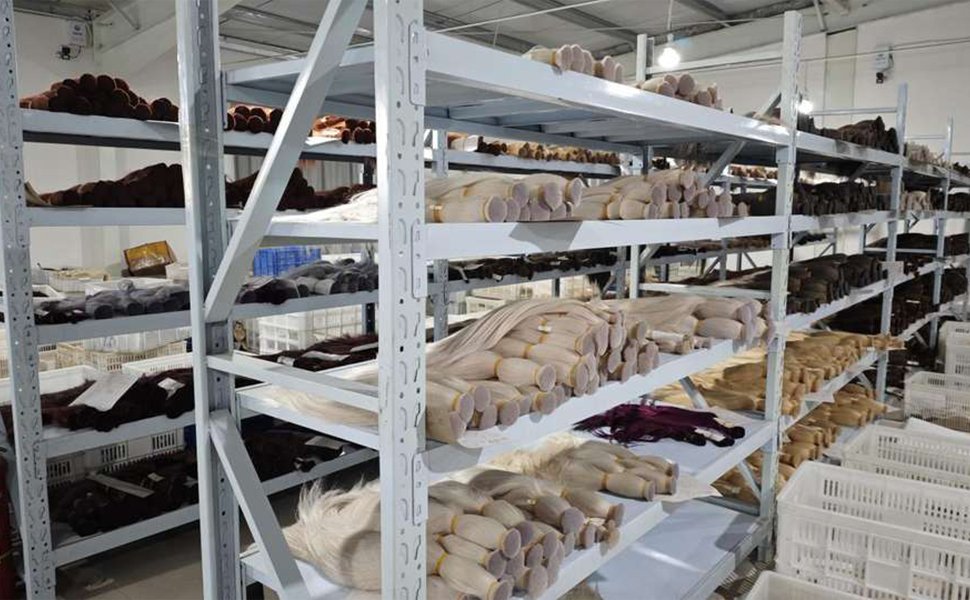
What makes this sequence worth understanding is not the process itself — it is what gets quietly removed when a supplier needs to lower cost. The eight steps are not equal in consequence. Two or three of them are structural: if they are done poorly or out of order, the finished bundle is already compromised before it reaches your customer. The rest of this article walks through each step with that lens.
Step 1: Steam Washing — Why Does Softening Come Before Cleaning?
Most buyers assume raw hair just needs to be cleaned. The actual problem is that unwashed, untreated raw hair is too stiff and chemically uneven to process consistently downstream. Skipping proper steam treatment means the pulling and sorting steps later will yield uneven, brittle bundles.
Steam washing is a two-phase process: steam softens the hair shaft structure, and a temperature-controlled alkaline wash removes odor, sebum, and surface contaminants. Both phases must happen in sequence. Cleaning without prior steaming leaves the cuticle layer rigid and prone to breakage during mechanical processing.

The practical details here carry real downstream weight. In our production process, hair is layered evenly on a steaming rack and steamed for 60 to 90 minutes [exact parameters to verify with production team]. The wash that follows uses water held between 40°C and 50°C. An alkaline solution — typically soda powder in measured concentration — is added to the wash water along with a small amount of alcohol to break down residual oils.
What Goes Wrong When This Step Is Shortened
The temptation to cut this step is real: steaming is time-consuming and energy-intensive. A supplier running on thin margins may reduce steaming time or skip the temperature control on the wash. Here is what that produces downstream:
- Uneven softness across the bundle. Some sections of the hair remain rigid. During the pulling step, rigid sections break or pull unevenly, creating short fragments inside the finished bundle.
- Residual odor that persists through the finished product. This is one of the most common complaints we hear from buyers switching from cheaper suppliers. The smell is not from the raw hair — it is from inadequate alkaline washing.
- Cuticle damage from forced mechanical processing. If hair is not properly softened before it enters the pulling stage, the mechanical force required to pull it damages the cuticle layer. Damaged cuticles cause tangling — not immediately, but within weeks of use.
After washing, the hair is rinsed with clean water, hand-wrung, and laid out to dry to approximately 90% dryness before the next step. That dryness threshold matters: too wet and the hair cannot be torn apart cleanly; too dry and it becomes statically charged and unmanageable.
Step 2: Tear-and-Hang Sorting — Why Must Hair Be Deliberately Disordered Before It Is Ordered?
This step seems counterintuitive. Hair that has just been cleaned and dried is deliberately torn apart — made into a loose, irregular mass. Buyers who visit factories for the first time sometimes assume this is careless handling. It is the opposite.
The tear-and-hang step breaks up any natural clumping or directional bias in the washed hair before it enters mechanical alignment. Hair that goes into the pulling step in pre-formed clumps will produce bundles with uneven hair distribution — thick in some sections, thin in others. Tearing first creates a consistent, randomized starting mass.
The Detail That Most Buyers Miss: White Hair Removal
During the tearing process, white and grey hairs are removed by hand. This is not a cosmetic step. White hair has a different structural composition — it has lost its cortical melanin and often behaves differently under dyeing and chemical treatment. Bundles that contain significant white hair percentages will show uneven color uptake when the end customer dyes or tones them.
Suppliers who skip manual white hair removal at this stage cannot easily remove it later. By the time the hair is bound into a finished bundle, individual strand removal is impractical.
After tearing, the hair is hung on a single-sided comb rack, with both ends drawn even. This establishes the initial alignment that the pulling step will refine into precise length grades.
Why Sequence Integrity Matters Here
If the tear step is skipped entirely and the hair goes directly from washing to the rack, the result is not a minor quality variation. It is a structurally different product. The pulling step (Step 3) is calibrated to work with a randomized input mass. Feeding it pre-clumped hair breaks the output consistency of every length grade pulled downstream.
Step 3: Hand Pulling — The Step That Defines Length Grading Accuracy
Length grading is the single most technically demanding step in bulk hair manufacturing. It is also the step most likely to be misrepresented in supplier spec sheets, because there is no simple way for a buyer to verify grading accuracy without measuring samples systematically.
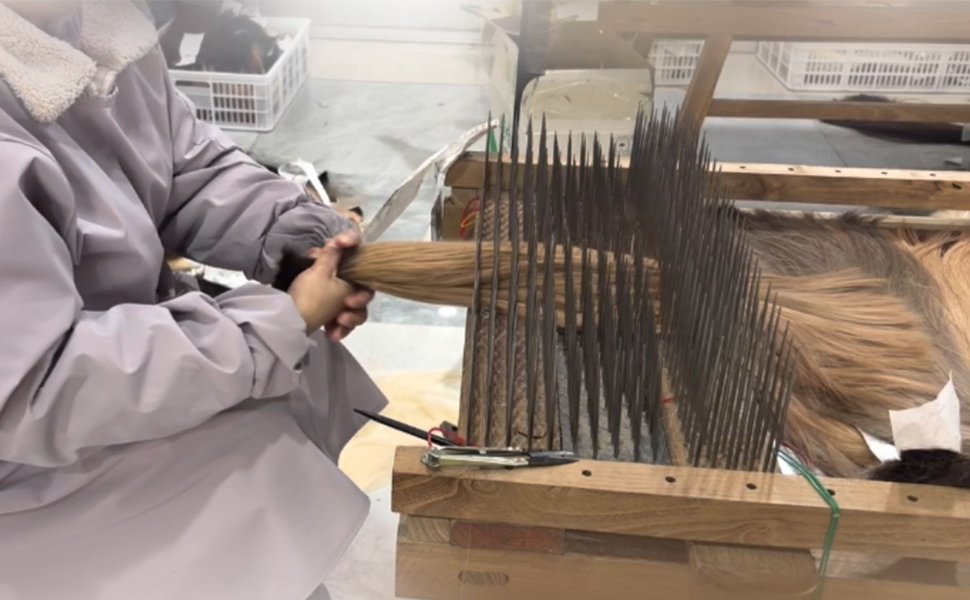
Hand pulling is the process of mechanically separating hair into precise length grades using a dual-comb pulling board. Hair is loaded between upper and lower combs, then pulled from each end using tweezers — first one end (first grade), then the other (second grade) — and sorted by length from longest to shortest: 20 inch, 18 inch, and down to 3–4 inch.
The Skill Component That Cannot Be Automated
This step is described in traditional bulk hair manufacturing as the point where worker skill is most visible. The tweezers must be held with consistent pressure and direction. One hand pulls, the other receives and holds the drawn hair firmly. If the receiving hand loosens its grip, the pulled section falls back into the unsorted mass — and the work must be restarted.
The operational standard is precise: stable grip, accurate placement, firm control. Workers who are not experienced in this step produce length grades that are inconsistent — a bundle labeled "18 inch" may contain significant amounts of 16-inch and 15-inch hair mixed in.
What Buyers Should Check in Samples
This is a step where buyers have concrete leverage at the sample evaluation stage. Here is a simple check:
- Take a received sample bundle.
- Pull 10–15 strands from different positions within the bundle — not all from the root end.
- Measure each strand individually.
- Calculate the range: how many strands fall within ±0.5 inch of the labeled length?
A well-pulled bundle from a disciplined production line should show tight clustering around the labeled length. A bundle from a supplier who rushed this step will show a wide spread — sometimes 2–3 inches of variation within a single labeled grade.
Length Grade Sequence in Practice
| Grade Label | Approximate Pull Length | Typical Application |
|---|---|---|
| 20 inch | 50 cm | Full-length extensions, luxury bundles |
| 18 inch | 45 cm | Standard retail bundles |
| 16 inch | 40 cm | Mid-length extensions |
| 10–14 inch | 25–35 cm | Shorter styles, transitional lengths |
| 3–4 inch | 7–10 cm | Filler material, craft applications |
Each grade, once pulled, is bound immediately with a cord into a temporary bundle and set aside in its length category. The separation must be maintained through all subsequent steps.
Step 4: Comb-and-Pat Alignment — Why Does the Root End Need to Be Physically Struck?
After pulling and temporary binding, hairs within the same grade still have minor directional irregularities. The comb-and-pat step resolves them. It seems like a finishing detail — but the alignment it creates is what makes the bundle binding step structurally sound.
Comb-and-pat alignment combines mechanical combing with repeated flat-paddle striking at the root end of the bundle. The combing removes tangles introduced during pulling. The paddle striking physically compacts and levels the root end so that bundle binding applies even pressure across all strands, not just the outermost ones.
In practice, the bundle is wrapped in a cloth with approximately one inch of the root end exposed. A flat wooden paddle strikes the exposed root end with even, controlled force until the end is visually flush and compact. The bundle is then re-bound before moving to the next step.
Suppliers who skip this step produce bundles where the root binding covers an uneven surface. When the buyer or end customer cuts or trims from the root, the bundle unravels unevenly. This is one of the most common sources of perceived "shedding" that buyers report — it is not the hair shedding; it is a binding that was never applied to an aligned surface.
Step 5: Bundle Binding — What Makes a Dead Knot Different From a Regular Knot?
Bundle binding is the step that assigns the finished bundle its permanent structure. Done correctly, it locks the length grade in place and prevents individual strands from shifting upward or downward inside the bundle.
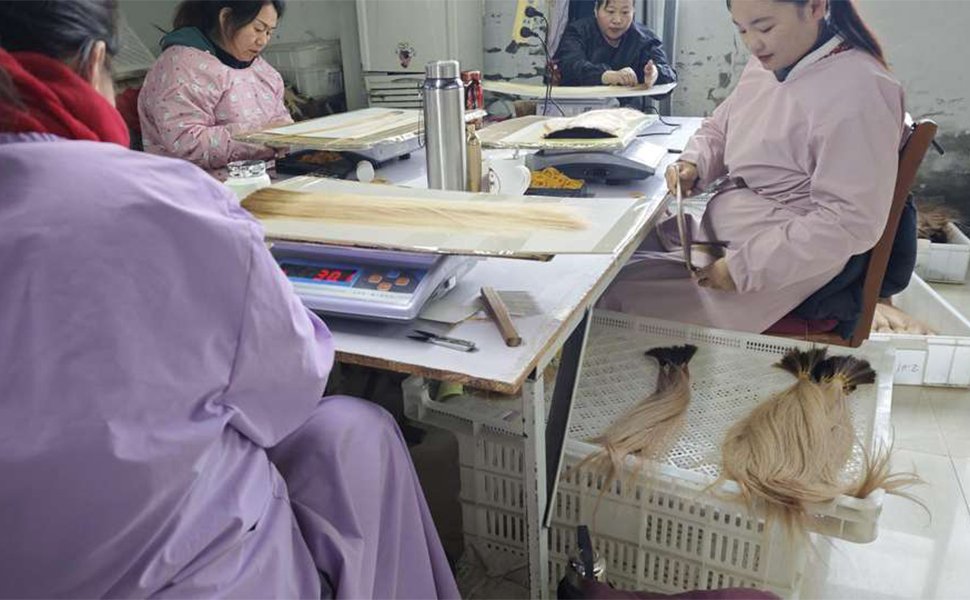
Bundle Binding requires each bundle to be hung vertically on a hook, combed downward under tension, and bound with thread using a specific knot pattern — finished with a tightened dead knot applied with pliers. The dead knot prevents the binding thread from loosening under tension, which is the primary mechanical cause of in-use shedding.
Why Pliers Are Required, Not Optional
A hand-tightened knot compresses to a certain tension limit, then holds there. A plier-tightened dead knot goes beyond what hand pressure can achieve. The difference matters because bundles are shipped, handled, and processed multiple times before they reach the end user. A hand-tightened binding will loosen incrementally under that handling load. A plier-set dead knot will not.
The binding thread distribution also matters. Evenly spaced thread lines along the bundle create uniform internal compression. Uneven thread spacing — which happens when this step is rushed — creates zones of loose and tight compression within the same bundle. That inconsistency becomes visible when the bundle is later sewn into a weft or clipped for installation.
Quality Markers a Buyer Can Check
- Visual: Thread lines should be evenly spaced and the same tension throughout.
- Tactile: Squeeze the bound section. It should feel firm and consistent, not softer in some areas than others.
- Length markers: Each bundle should have its grade marking visible on the binding — not on a separate tag that can be switched.
Step 6: Guillotine Cutting — Why Does the Final Cut Require Full Force?
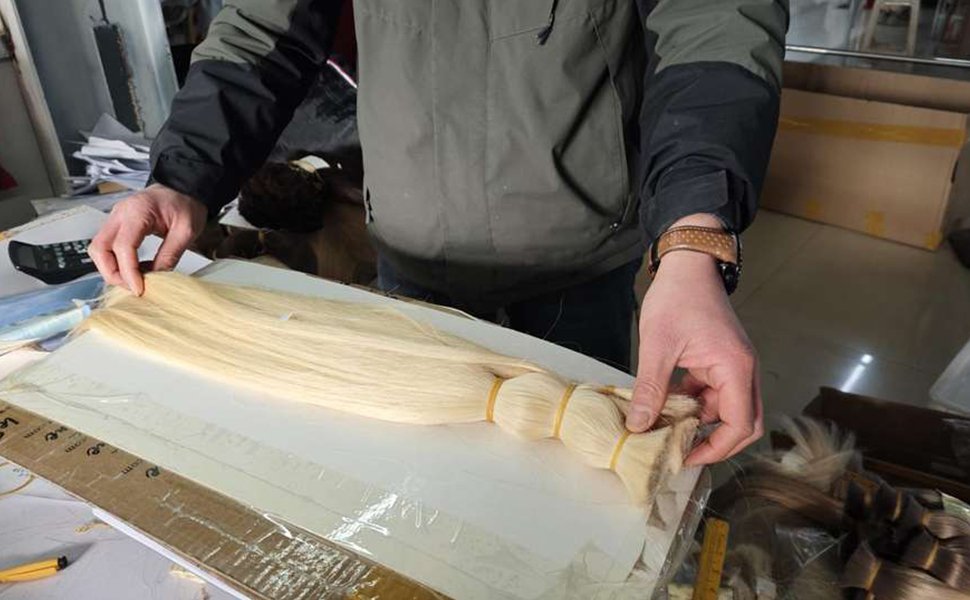
The final step in bulk hair manufacturing is cutting. After binding, the bundle ends are trimmed to exact specification using an guillotine cutter mounted on a calibrated cutting bed.
Guillotine cutting requires the operator to align the bundle against the length markings on the cutting bed, apply firm downward pressure to hold the bundle flat, and then cut in a single, full-force motion. A partial or hesitant cut produces a ragged edge — which must then be manually trimmed with scissors, adding time and introducing inconsistency.
The Overlooked Consequence of Imprecise Cutting
Length accuracy at the cutting step is the last chance to correct errors introduced in the pulling step. If the pulling produced a bundle that is marginally longer than labeled, a clean guillotine cut can bring it to spec. If the cut is imprecise — off-angle, partial force, misaligned to the scale — it compounds the error.
A clean cut end also serves a functional purpose for the end customer: it is the reference point from which installation length is measured. A ragged cut end forces the installer to trim further in, reducing the usable length below what the label states.
Frequently Asked Questions
Does raw hair quality matter more than the manufacturing process?
Raw hair quality sets a ceiling, but manufacturing process determines whether you reach it. We have seen bundles made from decent raw hair that shed badly within weeks — because the pulling step was rushed and the binding was applied to misaligned strands. Process failure consistently outweighs raw material quality as a cause of buyer returns.
How can I tell if a supplier skipped the steam washing step?
The most reliable indicator is residual odor in the sample. Properly steam-washed and alkaline-rinsed hair should have no strong smell after drying. A persistent ammonia-like or organic odor in a dry sample suggests the wash step was shortened or the water temperature was not controlled.
What is the fastest single check I can do on a received sample?
Measure 10–15 individual strands pulled from different positions in the bundle. If the length variation exceeds ±1 inch from the labeled grade, the pulling step was not executed to standard. This check takes under five minutes and reveals more about production discipline than any spec sheet.
Why do some cheaper bundles look fine initially but fail after a few washes?
The initial appearance of a bundle does not reveal whether the cuticle layer is intact. Cuticle damage caused by insufficient steaming or aggressive mechanical pulling looks normal until the hair is wetted and dried several times. The damaged cuticle scales catch on each other during handling, which produces tangling that worsens progressively.
Should I ask suppliers to provide a step-by-step production sequence?
Yes. Ask specifically for the documented step sequence on their spec sheet, not a general quality statement. A supplier who can describe the sequence in operational terms — including the order, the material inputs at each step, and the quality checkpoints — is more likely to be executing it consistently than one who responds with general assurances.
Conclusion
The price difference between bulk hair suppliers rarely comes down to the raw hair itself. It comes down to which of these eight steps — steam washing, tear-and-hang sorting, hand pulling, comb-and-pat alignment, bundle binding, and guillotine cutting, plus upstream cuticle and acid processing — a supplier executes fully, in order, and with the skill each step requires. At Xpertric, our production lines in Juancheng follow this sequence as a non-negotiable standard, because we have seen the return and complaint costs that follow when any step is shortened. If you are currently evaluating bulk hair suppliers, do not rely on price alone. Ask your supplier to walk you through their production step sequence — and measure the answer against what you have read here.