
If you've ever placed a hair extension order and received something that looked noticeably thinner — or thicker — than expected, you already know the problem. Density and ratio specs sit quietly on supplier quotes, easy to overlook and even easier to misread. Getting them wrong doesn't just cost you money. It costs you client trust.
Hair extension ratio refers to how hair weight is distributed from root to tip along the weft or bundle. A ratio like 20% or 25% means a specific proportion of the total hair weight is allocated to the lower section of the extension, determining how full or tapered the ends appear. Understanding this number is one of the most practical skills a wholesale buyer can develop before writing a purchase order.
Density sounds technical, but it is really a sourcing variable — not a quality badge. Once you understand what the number actually describes, comparing quotes across suppliers becomes much more straightforward. Let me walk you through everything you need to know.
1) What Does the Ratio Mean for Hair?
Most wholesale buyers know weight. They know what 100 grams looks like. But ratio? That's where orders go wrong. Misreading a density spec — or skipping it entirely — is one of the most common reasons buyers receive goods that don't match expectations and have no clean path to dispute resolution.
The ratio in hair extensions describes how hair volume is distributed from the top of the weft to the bottom. It is not the same as total weight. A higher ratio means more hair is concentrated toward the ends of the extension, producing a fuller, thicker tip. A lower ratio produces a more tapered, natural-looking end.
Density vs. Weight: Two Different Numbers on the Same Spec Sheet
This is the most common point of confusion we hear from wholesale buyers — and it's understandable. Both numbers appear on supplier quotes, sometimes right next to each other.
- Weight (grams per pack): This is a quantity metric. It tells you how much hair is in the package. Two packs can both weigh 100g and still look completely different.
- Density ratio (%): This is a distribution metric. It tells you where the weight sits along the hair strand — and how full the extension looks, especially at the ends.
You can have a 100g weft with a 15% ratio and a 100g weft with a 40% ratio. They weigh exactly the same. But they look and feel very different when installed.
A buyer who compares quotes by weight alone is missing half the specification. Weight tells you how much. Ratio tells you what it looks like.
Where Suppliers List This Spec — and Where It Gets Ambiguous
Based on inquiries we handle regularly, density notation appears in a few different formats depending on the supplier:
| Notation Format | What It Describes |
|---|---|
| 20%, 25%, 30% | Ratio of hair at lower section relative to total |
| 150%, 180%, 200% | Common in wigs and clip-ins; fullness relative to a baseline volume |
| "Natural density" | Vague — no universal standard, supplier-defined |
| "Full density" or "double drawn" | Marketing language; needs clarification with specs |
The wig and clip-in market often uses a different percentage scale entirely — 150%, 180%, 200% — which refers to how full the piece looks relative to a reference standard. This is not the same system as the 15%–50% ratio scale used for wefts and bundles. Mixing up these two systems when comparing supplier quotes is a real sourcing risk.
When you receive a quote that simply says "natural density" without a number, ask for the actual ratio. Any professional supplier should be able to provide it. If they can't, that's a useful signal.
Why Density Isn't Always "Higher = Better"
This is worth saying directly: defaulting to the highest available ratio is a common over-specification mistake.
More density adds weight. More weight means higher cost. But it also means the extension may not blend naturally with the end-wearer's own hair — especially if their natural hair is fine or medium in volume. A high-density extension installed on fine natural hair creates an obvious mismatch at the blend line.
The right density is the one that matches the end-wearer's natural volume. Buyers who understand this can make smarter sourcing decisions — and brief their salon clients more accurately.
2) Hair Ratio Categories: 15%, 20%, 25%, 30%, 35%, 40%, 50% — What's the Difference?
Choosing between ratio options without visual context is frustrating. Buyers often receive a range of percentage options on a quote and have no reference point for what each one actually looks like. That gap between spec sheet and physical product is where disputes start.
Hair extension ratios typically range from 15% to 50%. The higher the percentage, the more hair weight is concentrated at the lower end of the extension, producing thicker, fuller tips. Each step up in ratio produces a visible difference in end density — and a corresponding increase in cost, since more processed hair is required per unit.
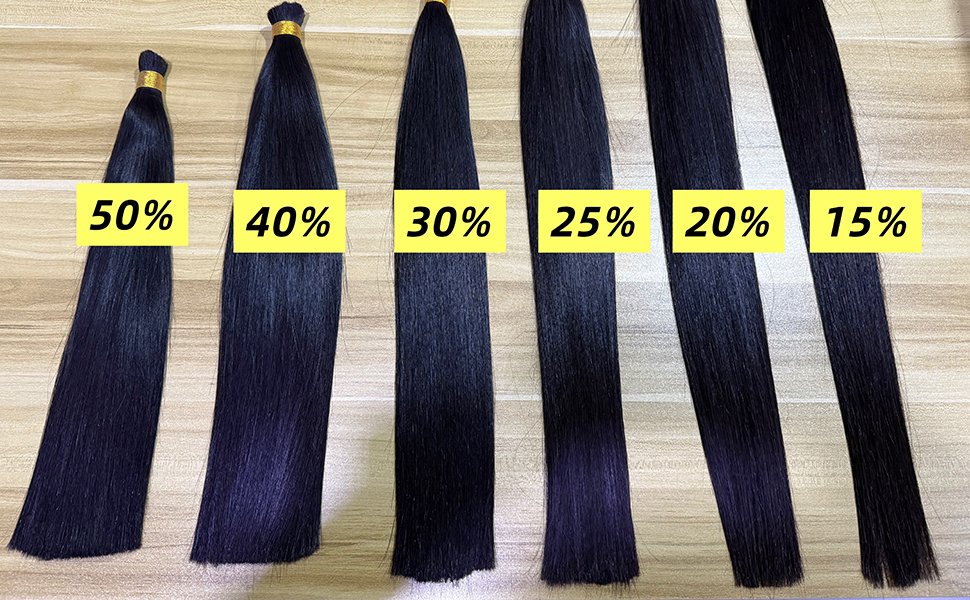
A Breakdown of Each Ratio Level
Below is a practical reference for how each ratio category behaves. I'll be adding video demonstrations of each level — those will be linked here once published.
15% — Most Tapered
- Very thin at the ends
- Mimics the natural taper of unprocessed human hair
- Best suited for blending with fine hair types
- Lowest cost per unit at equivalent weight
20% — Lightly Full
- Slight fullness at the ends
- Good natural appearance for most hair types
- A strong everyday choice for salon-ready product lines
- Cost-effective for high-volume B2B orders
25% — Balanced
- Noticeably fuller ends without appearing heavy
- Works across a wide range of natural hair volumes
- Popular with salons serving mixed clientele
- Good middle-ground spec for distributors
30% — Moderately Full
- Visible end thickness
- Suited for clients with medium to thick natural hair
- Works well for volume-focused styles and blowouts
- Higher cost than 20%–25%; justifiable for premium lines
35% — Full
- Clearly full at the tips
- Better suited for thick hair types
- Risk of mismatch on fine hair
- Common in full-volume glamour or event-focused product lines
40% — Very Full
- Heavy, dense ends
- Used in voluminous styles, wigs, and theatrical product
- Significant cost premium; not recommended for standard inventory
- Requires accurate end-wearer profiling before ordering
50% — Maximum Density
- The fullest available option
- Specialty use — stage, editorial, or maximum-volume applications
- Not recommended for everyday or salon redistribution
- Highest cost tier; slowest general-market sell-through
How Ratio Affects Cost: A Simple Comparison
| Ratio | End Appearance | Relative Cost | Best Application |
|---|---|---|---|
| 15% | Very tapered | Lowest | Fine hair, natural blend |
| 20% | Lightly full | Low | Everyday salon use |
| 25% | Balanced | Moderate | Mixed clientele, general retail |
| 30% | Moderately full | Medium | Thick hair, volume styles |
| 35% | Full | Medium-high | Full-volume product lines |
| 40% | Very full | High | Specialty, event use |
| 50% | Maximum | Highest | Stage, editorial, theatrical |
Ratio by Extension Type
It's also worth noting that ratio benchmarks differ across product categories. A question we frequently receive from wholesale buyers is whether the same ratio scale applies to wefts, tape-ins, and clip-ins. The short answer: the percentage system is consistent, but the visual outcome differs by product type.
- Weft extensions: Ratio is most visible. End density is clearly apparent when the weft is held up or installed.
- Tape-in extensions: Thinner panels mean ratio differences are subtler but still affect blend quality.
- Clip-in extensions: Multiple wefts are layered, so cumulative density matters more than single-piece ratio.
If you're sourcing across multiple product types for redistribution, don't assume the same ratio spec will produce the same visual result.
3) How to Choose the Right Ratio for My Business?
Sourcing decisions made without end-wearer context lead to inventory that sits. Buyers who have received confused feedback from their salon clients — "too thick," "doesn't blend," "looks fake" — are often tracing a problem that started on the spec sheet.
For most wholesale buyers supplying salons or general retail, a 20% or 25% ratio is the most practical and cost-effective choice. These ratios cover the widest range of natural hair volumes, produce a natural-looking result for everyday wear, and avoid the cost premium of higher-density options that most end-users don't actually need.
Why We Recommend 20%–25% for Everyday Use
This isn't a generic recommendation. It comes from handling order inquiries and post-delivery feedback across different buyer profiles.
Here's the reasoning:
- Most natural hair sits in a fine-to-medium volume range. Extensions at 20%–25% blend cleanly with the majority of end-wearers without a noticeable volume jump at the blend line.
- Salon buyers need versatility. A salon stocking one density level wants that level to work on as many clients as possible. 20%–25% provides the widest fit.
- Cost efficiency compounds at wholesale volume. The cost difference between a 20% and a 35% order may seem small per unit. Across a 500-piece order, it is not.
- Returns and exchanges are reduced. When extensions match a wider range of natural hair types, the rate of "doesn't match my hair" complaints drops significantly.
When to Deviate From the 20%–25% Default
There are legitimate reasons to order outside this range. The key is intentionality — ordering a specific ratio because your customer profile calls for it, not because a supplier listed it first.
Consider 15% when:
- Your market skews toward fine-hair demographics
- You are producing a "natural blend" product line
- Price sensitivity is high and end-users have naturally thin hair
Consider 30%–35% when:
- Your salon clients primarily serve thick or coarse hair textures
- You are building a volume-focused or glamour product line
- End-wearer feedback has specifically requested fuller ends
Consider 40%–50% when:
- You are producing specialty or event-focused SKUs
- You have a confirmed buyer segment with thick natural hair
- You are willing to carry slower-moving premium inventory
How to Specify Density Correctly on a Purchase Order
Vague POs create disputed deliveries. This is not entirely buyer error — suppliers also carry responsibility for clear labeling and consistent production. But as a buyer, you can protect yourself by being specific.
When writing a PO or requesting a sample, include:
- The exact ratio percentage (e.g., "25% density ratio")
- The product type (weft, tape-in, clip-in)
- A request for a physical sample before bulk production if this is a new spec
- A reference to any approved sample already on file
- A clause requesting that production match approved sample density within an acceptable tolerance
If a supplier cannot confirm the density ratio in writing, that is worth noting before the order is placed.
Frequently Asked Questions
What is the difference between density and weight in hair extensions?
Weight (grams) measures how much hair is in a pack — it is a quantity metric. Density ratio (%) measures how that hair is distributed from root to tip — it is a fullness metric. Two packs can weigh exactly the same and look completely different, depending on their ratio.
Is a higher hair extension ratio always better quality?
No. A higher ratio means thicker ends, not higher quality. Quality refers to the hair material, processing, and cuticle alignment. Ratio is a separate spec that describes fullness. Ordering a high ratio when your end-users have fine hair can actually produce worse results than a lower ratio.
Why do some suppliers list density as 150% or 180% instead of 20% or 30%?
These are two different notation systems. The 150%–200% scale is commonly used for wigs and clip-in pieces, referring to fullness relative to a baseline standard. The 15%–50% scale is used for wefts and bundles, describing the ratio of hair at the ends. Do not mix these systems when comparing quotes.
How do I know if a supplier's density matches what was quoted?
Request a pre-production sample and compare it against your approved spec. When placing a PO, document the exact ratio in writing and reference the approved sample. If a supplier cannot provide a confirmed ratio specification in writing, treat that as a sourcing risk.
Does the right density ratio differ between wefts, tape-ins, and clip-ins?
Yes. The percentage scale is consistent, but visual outcomes differ by product type. Weft extensions show ratio differences most clearly. Tape-ins show subtler differences due to panel thickness. Clip-ins involve layered wefts, so cumulative density across the set matters more than any single piece.
Conclusion
Hair extension density ratio is not a quality label — it is a sourcing variable. Understanding what the ratio number actually describes, how it differs from weight, and how it translates to a visual outcome gives you a concrete advantage when comparing supplier quotes, writing purchase orders, and briefing your team. For most wholesale buyers supplying salons or general retail markets, a 20% or 25% ratio covers the widest range of end-users and offers the best balance between natural appearance and cost efficiency. Step outside that range only when your specific customer profile calls for it.
If you're currently evaluating density specs on a supplier quote and want a second opinion — or if you're ready to request samples across ratio levels — reach out to the Xpertric team at info@xpertric.com or visit www.xpertric.com. We work with wholesale buyers to get the spec right before the order is placed, not after.