Sourcing hair extensions sounds straightforward — until you realize the same word "raw" appears on everything from premium virgin bundles to acid-washed commodity hair. If you can't distinguish between material grades, you're making a margin decision blind. Here's what the label isn't telling you.
Raw hair material falls into four main grades: Virgin Hair, Remy Hair, Non-Remy Hair , and Cuticle Hair. Each grade differs in cuticle integrity, chemical processing history, and durability. Understanding these differences is not a quality preference — it's a sourcing decision that directly affects your return rates, customer retention, and profit margins.
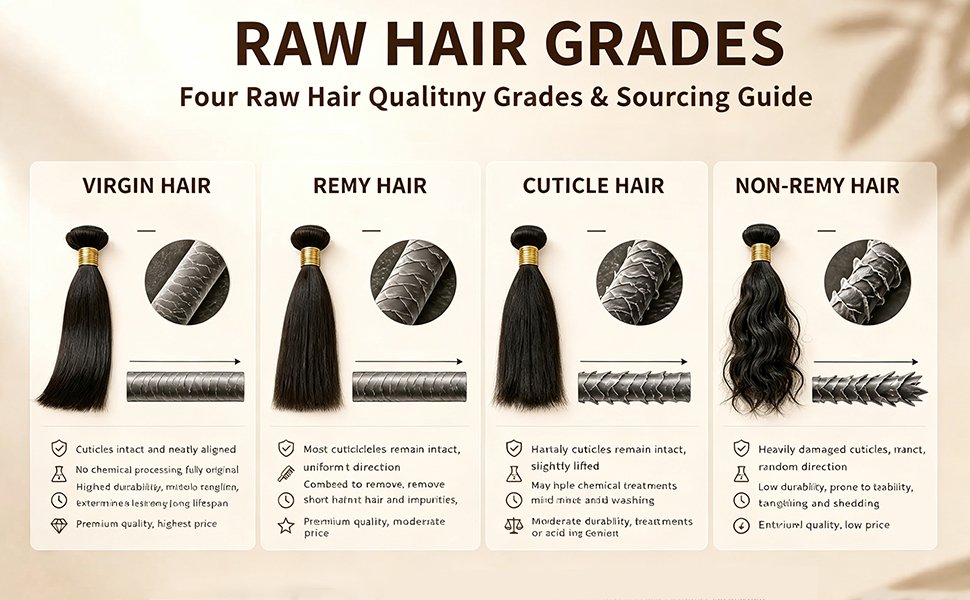
These four grades are not interchangeable, even though suppliers — and buyers — often treat them as if they are. The sections below break down each one with the verification logic you need before committing to a large order.
What Are Raw Hair Extensions?
Most buyers enter the market assuming "raw" means unprocessed. That assumption is expensive.
Raw hair extensions are hair bundles sourced directly from a single donor and collected without chemical alteration. In a strict procurement sense, raw hair is synonymous with virgin hair — cuticle-intact, uncolored, unpermed, and uncoated. However, in the wholesale market, the word "raw" carries no regulated definition and no certification requirement.
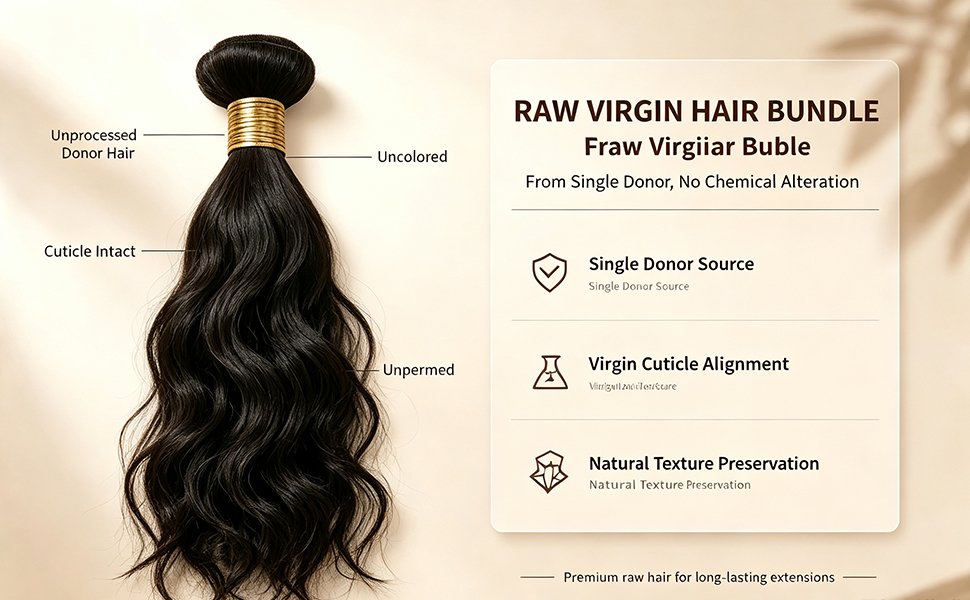
That gap between the marketing claim and the material reality is where most sourcing mistakes happen. Understanding what raw hair actually means — and how to verify it — starts with knowing all four material grades in the market.
The Four Grades of Raw Hair Material
In our sourcing process at Xpertric, we evaluate material against four distinct categories. Here is how they stack up:
| Grade | Chinese Term | Cuticle Status | Chemical Processing | Typical Use Case |
|---|---|---|---|---|
| Virgin Hair | 辫发 | 100% intact | None | High-end retail, luxury brands |
| Remy Hair | 顺发 | Aligned, may be processed | Light to moderate | Mid-to-high market |
| Non-Remy Hair | 泡发 | Removed by acid wash | Heavy | Budget products, short lengths |
| Cuticle Hair | 保鳞发 | Fully preserved, enhanced | None | Ultra-premium market |
Each grade has a legitimate market application. The problem is not that Non-Remy Hair exists — it's that it gets sold as something it isn't.
Virgin Hair: The Benchmark Grade
Virgin Hair is cut directly from a single donor's head. No chemical processing. No dyeing. No perming. The cuticle layers are fully intact and running in one direction from root to tip.
Because the cuticle is undamaged, virgin hair can accept any color — including light shades like #613 and #60 — without unpredictable results. Color consistency is reliable because the hair hasn't been pre-treated.
Key procurement signal: If a supplier claims their bundles are virgin but cannot lift to blonde without significant breakage or uneven tone, the material has likely been pre-processed.
Remy Hair: The Most Misunderstood Grade
Remy Hair means the cuticles are aligned — root-to-tip direction is maintained throughout the bundle. That's the definition. It says nothing about whether the hair has been chemically treated.
- Natural Remy: Not permed or dyed. Can accept a wide range of color treatments.
- Processed Remy: Has been through multiple chemical processes. Can typically only be dyed to darker shades without risking structural damage.
A common quality issue in the wholesale market: Remy bundles blended with Non-Remy hair to reduce cost. The blend is difficult to detect visually, but it shows up clearly after washing.
Buyer risk: Paying Remy prices and receiving blended or Non-Remy material is one of the most frequent margin losses we see in B2B hair sourcing.
Non-Remy Hair: The Commodity Grade
Non-Remy Hair is collected from shed hair — floors, brushes, and similar sources. Because the cuticle directions are mixed, the hair is put through an acid wash to strip the cuticle layer entirely. A silicone coating is then applied to give it temporary smoothness.
- The silicone washes out. After one or two wash cycles, tangles and matting begin.
- Length limitation is real. Bundles over 14 inches become increasingly difficult to manage without the cuticle layer providing structural alignment.
- It has a legitimate market. Short-length clip-ins, budget weft extensions, and certain male hairpiece products can use Non-Remy without misrepresenting quality — as long as pricing reflects the grade.
The problem, again, is mislabeling.
Cuticle Hair: The Ultra-Premium Tier
Cuticle Hair starts with the best-quality Virgin Hair — no dyeing, no damage, no curl treatment — and then applies a specialized production process that keeps the cuticle layer fully protected throughout manufacturing.
This is not a common category in mid-market B2B. It targets luxury retail and brand positioning where the end consumer has high expectations and the price point supports the sourcing cost. For most wholesale buyers, Virgin Hair is the practical ceiling. Cuticle Hair is relevant only when you're building a product line at the absolute top of the market.
How Long Do Raw Hair Extensions Last?
Buyers consistently underestimate how much longevity depends on material grade — not just care routine.
Raw virgin hair extensions, when properly maintained, can last 1–2 years or longer. Remy hair typically lasts 0.6–1 years under regular use. Non-Remy hair, due to the absence of a natural cuticle layer, often shows significant tangling and quality degradation within 3–6 months, even with careful maintenance.
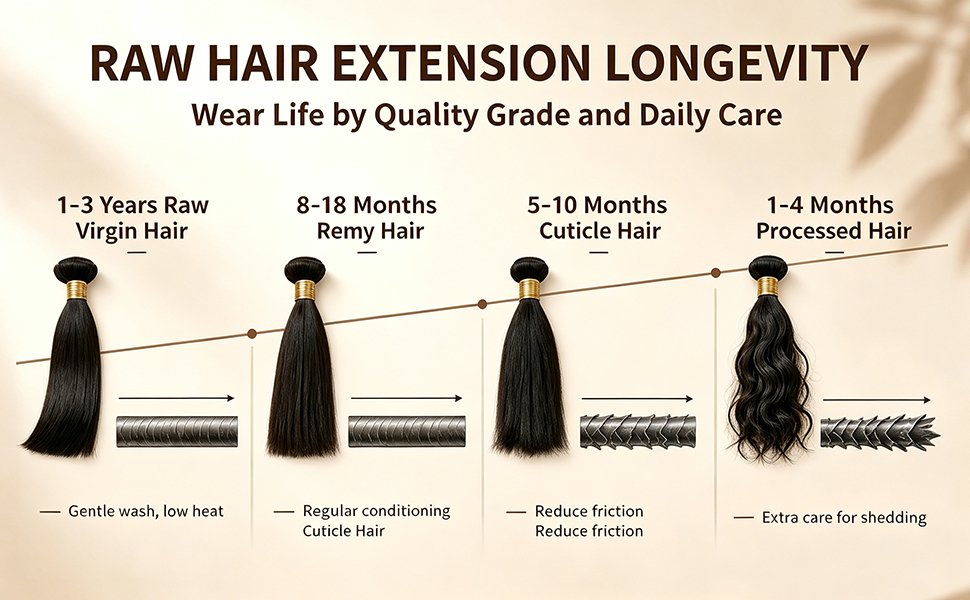
Longevity is not just a consumer experience issue. For B2B buyers who rebrand and resell, product lifespan is a direct driver of customer retention and return rates. Here's how material grade affects the timeline in practice.
Why Material Grade Determines Shelf Life
The cuticle layer is the structural protection system of human hair. When it's intact and aligned, the hair resists tangling, holds moisture, and accepts color without excessive damage. When it's stripped — as in Non-Remy — or misaligned, the hair degrades much faster.
Lifespan benchmarks by grade:
- Virgin Hair: 1–2+ years with standard care. Color-treated virgin hair: 1.5–2 years depending on processing frequency.
- Natural Remy Hair: 1+ years. Performance drops faster if re-colored repeatedly.
- Processed Remy Hair: 6–12 months before noticeable quality decline, especially with further chemical treatments.
- Non-Remy Hair: 3–6 months before matting and shedding become customer complaints.
The Hidden Cost of Short Lifespan for Resellers
I want to be direct about this point because it's where many buyers miscalculate their real cost of goods.
If you source Non-Remy at a low per-bundle cost and your retail customer replaces the product after four months, you are not selling a sustainable product. You're selling a one-cycle purchase. The math looks like this:
Lower upfront cost + high return rate + lost reorder = negative margin on a 12-month view
Buyers like wholesale distributors and salon suppliers depend on repeat business. A customer who has a bad experience with tangling or shedding doesn't reorder — they switch suppliers. The true cost of wrong material selection shows up 6–12 months after the invoice, not at the point of purchase.
Post-Wash Performance as a Verification Test
One of the most practical things you can do before placing a full order is request a trial batch and wash it. Here's what to observe:
- Shedding: Some shedding on first wash is normal. Excessive shedding after wash two or three indicates poor weft construction or blended material.
- Tangling: Virgin and quality Remy hair detangles easily when wet. Non-Remy or blended hair mats from the mid-shaft down.
- Sheen change: If the hair loses its smoothness after one wash, the smoothness was silicone-based, not structural.
This test doesn't require a lab. It requires ordering a sample before you commit to volume.
Why Is Raw Hair More Expensive?
The price difference between material grades is real — but it's not always explained honestly.
Raw virgin hair is more expensive because it comes from a single donor, is collected in limited quantities, undergoes no chemical processing that could mask quality defects, and retains the full cuticle structure that determines long-term performance. The supply chain is shorter, the selection criteria are stricter, and the quality cannot be artificially enhanced.
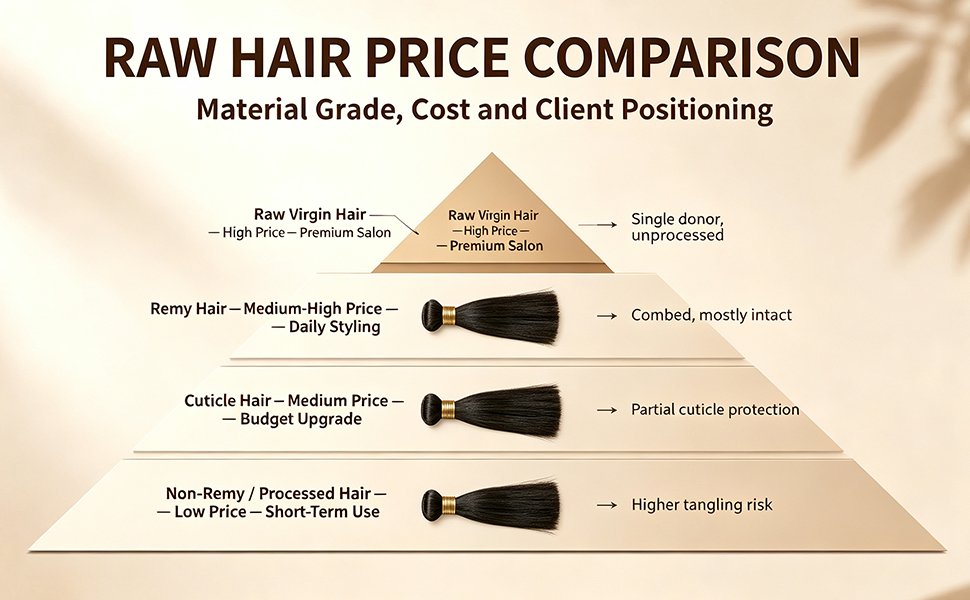
Understanding the cost drivers helps you evaluate whether a supplier's pricing is realistic — or a signal that something in the material claim doesn't add up.
The Supply Chain Behind the Price
Single-donor collection is the starting constraint. Virgin hair cut from one head in one session is inherently limited in volume. It cannot be blended to hit a color or length target. What you see is what the donor had. That scarcity has a real cost.
No chemical correction means the material must be selected correctly from the start. With Non-Remy, processors can acid-wash inconsistent hair and coat it into apparent uniformity. With virgin hair, there is no correction step. The sourcing standard is higher because the production process doesn't allow for quality repair.
Cuticle integrity takes time to verify. At Xpertric, when we evaluate new raw material suppliers, the first thing we check is cuticle condition — and that check cannot be rushed. Suppliers who provide properly documented and consistent virgin hair have invested in quality control infrastructure that commodity processors haven't.
Three Price-Integrity Signals for Buyers
If a supplier is offering "raw virgin hair" at prices comparable to standard Remy, one of three things is happening:
- The material is not actually virgin. It has been chemically processed and relabeled.
- The origin or donor pool is misrepresented. Blended sources passed off as single-donor.
- The pricing is a loss leader. Quality control is cut at some other stage you haven't seen yet.
A legitimate price gap between Non-Remy, Remy, and Virgin hair reflects real differences in collection, selection, and production cost. When that gap disappears, the quality difference doesn't disappear with it — it just becomes invisible until your customers notice.
Burn Test as a First-Pass Verification
Before investing in large quantities of any material claimed as raw or virgin, a simple burn test provides a first-pass signal:
- Genuine human hair burns slowly, produces a protein (burnt feather) smell, and leaves soft, crumbling ash.
- Synthetic fiber or heavily coated hair melts, produces a chemical or plastic smell, and leaves hard, beaded residue.
- Silicone-coated hair may pass the burn test but will fail the post-wash test — the coating burns normally, but the underlying cuticle condition reveals itself after washing.
This is not a definitive lab test. It's a screening tool. Use it alongside wash trials and sheen observation before finalizing a supplier decision.
Is Raw or Remy Hair Better?
This is the question buyers ask most often — and it's slightly the wrong question.
Raw virgin hair and Remy hair are not competitors in the same tier — they are different grades for different market segments. Raw virgin hair is unprocessed and cuticle-intact, making it the superior material for longevity, color versatility, and long-term performance. Remy hair is cuticle-aligned but may be chemically processed, making it a cost-effective mid-tier option. "Better" depends entirely on your target customer and margin model.
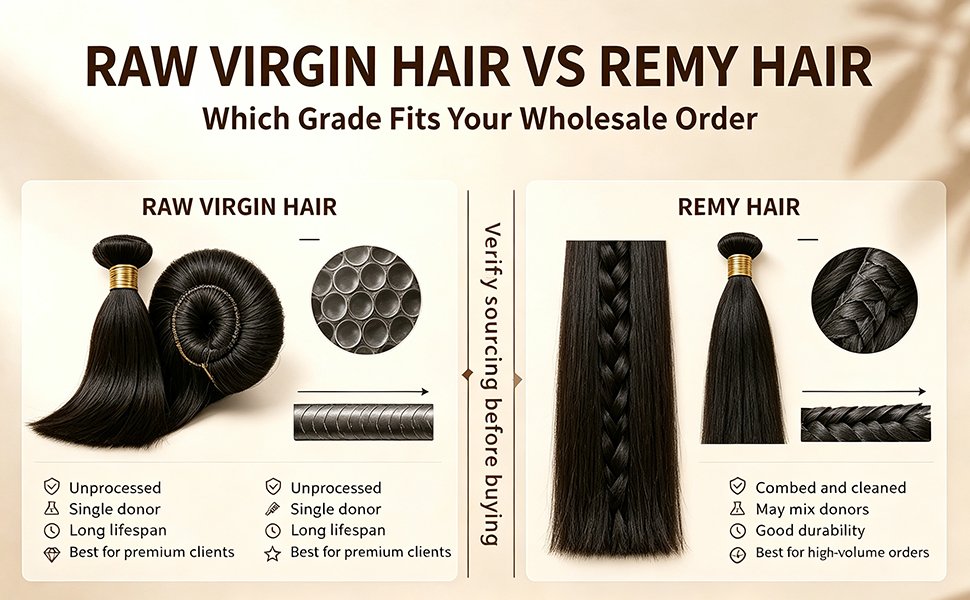
The more useful question is: which grade fits your price point, your end customer's expectations, and your supplier's ability to deliver consistently?
Side-by-Side Comparison
| Factor | Raw Virgin Hair | Remy Hair |
|---|---|---|
| Cuticle condition | 100% intact | Aligned, may be processed |
| Chemical treatment | None | Light to heavy depending on type |
| Color range | Full range including light blonde | Limited if heavily processed |
| Lifespan | 1–2+ years | 1 years |
| Tangle resistance | High | Moderate to high |
| Price point | Premium | Mid-range |
| Best market fit | Luxury retail, high-end salon | Mid-market, volume retail |
When Remy Is the Right Call
Not every buyer needs virgin hair. If your retail price point is mid-market and your customers replace extensions every 12 months anyway, well-sourced natural Remy is a commercially rational choice. The key word is well-sourced — meaning you've verified the cuticle alignment, confirmed it hasn't been blended with Non-Remy, and tested post-wash performance.
Natural Remy (unpermed, undyed) is the version worth paying for. Processed Remy — particularly hair that has gone through multiple chemical cycles — narrows your processing options significantly and degrades faster under retail conditions.
The Verification Gap That Creates Buyer Risk
The single biggest problem in the Raw vs. Remy decision is that neither claim is regulated. A supplier can label a bundle "raw" or "Remy" without any third-party verification requirement. That means the label is the beginning of your evaluation, not the end of it.
Practical verification steps before a full order:
- Request a sample. A supplier is willing to send samples before a bulk order is a risk signal.
- Run a burn test. Confirm it's human hair, not synthetic or heavily coated.
- Wash the sample. Observe tangling, shedding, and sheen change after two wash cycles.
- Attempt a color lift (if relevant to your product line). True virgin hair lifts predictably. Pre-processed hair does not.
- Ask for documentation. Certifications should be verifiable. Treat any certificate you cannot independently verify as unconfirmed.
Frequently Asked Questions
What is the difference between raw hair and virgin hair?
In strict procurement terms, raw hair and virgin hair refer to the same grade: hair collected from a single donor without any chemical processing, with the cuticle fully intact. However, "raw" is a marketing term with no regulated standard. Always verify through sampling and testing rather than relying on the label alone.
Can Non-Remy hair be sold honestly?
Yes. Non-Remy hair has legitimate applications in budget product lines, short-length extensions, and price-sensitive markets. The issue is not the material — it's mislabeling. Buyers should ensure the grade is accurately represented in contracts and product descriptions to manage customer expectations and avoid returns.
How can I tell if a supplier's "raw" claim is accurate?
Request a sample before any bulk commitment. Run a burn test to confirm human hair. Wash the sample twice and observe tangling and shedding. Attempt a color lift if your product line requires it. Ask for documentation and verify any certifications cited. These steps won't replace a full quality audit, but they screen out obvious misrepresentation.
Why does hair tangle after a few washes?
Tangling after washing almost always indicates one of two things: the cuticle layer has been stripped (Non-Remy), or the bundle is blended material with inconsistent cuticle direction. Silicone-coated hair feels smooth initially but loses that smoothness once the coating washes out, exposing the underlying cuticle damage.
Is country of origin a reliable grade indicator?
No. Country-of-origin labels — Brazilian, Indian, Vietnamese, and so on — describe where the hair was collected or processed, not the material grade. A "Brazilian bundle" can be Non-Remy. A "Vietnamese bundle" can be genuine virgin hair. Grade is determined by cuticle integrity and processing history, not geography.
Conclusion
The types of raw hair material — Virgin, Remy, Non-Remy, and Cuticle Hair — each have a legitimate place in the market. The procurement problem is not that lower grades exist. It's that grade claims are unregulated, and buyers who can't verify them pay premium prices for commodity material. Whether you're evaluating raw hair for a luxury product line or sourcing Remy for a mid-market brand, the decision framework is the same: verify before you commit, test before you scale, and treat the label as a starting point.